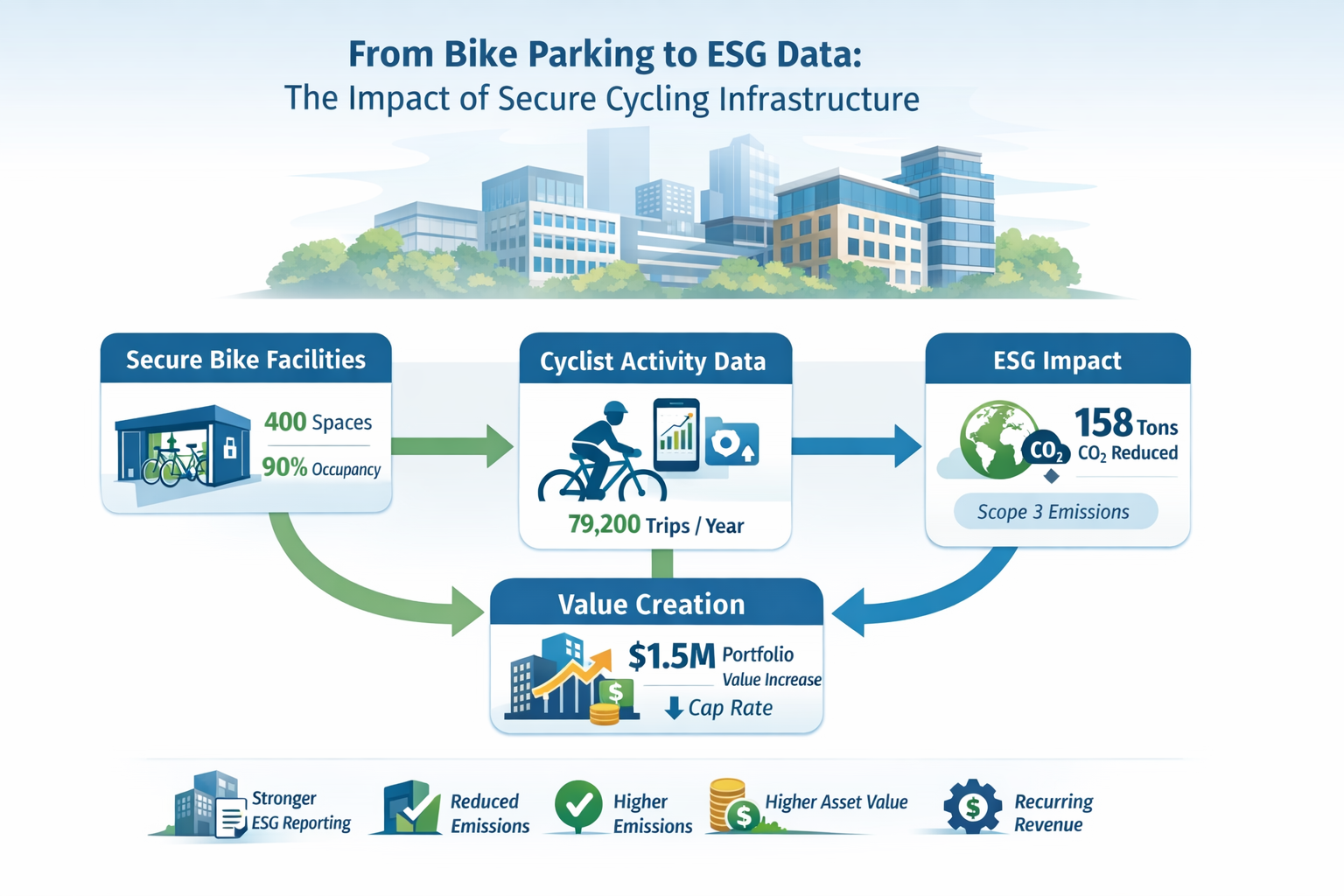
From Bike Parking to ESG Data Infrastructure
Real estate ESG strategies often focus on energy and building performance—but overlook one of the largest sources of emissions: commuting. Secure cycling infrastructure, when connected to digital mobility platforms, can transform bike parking into a measurable ESG asset. The result is a new opportunity to reduce Scope-3 emissions while strengthening the long-term value of real estate portfolios.
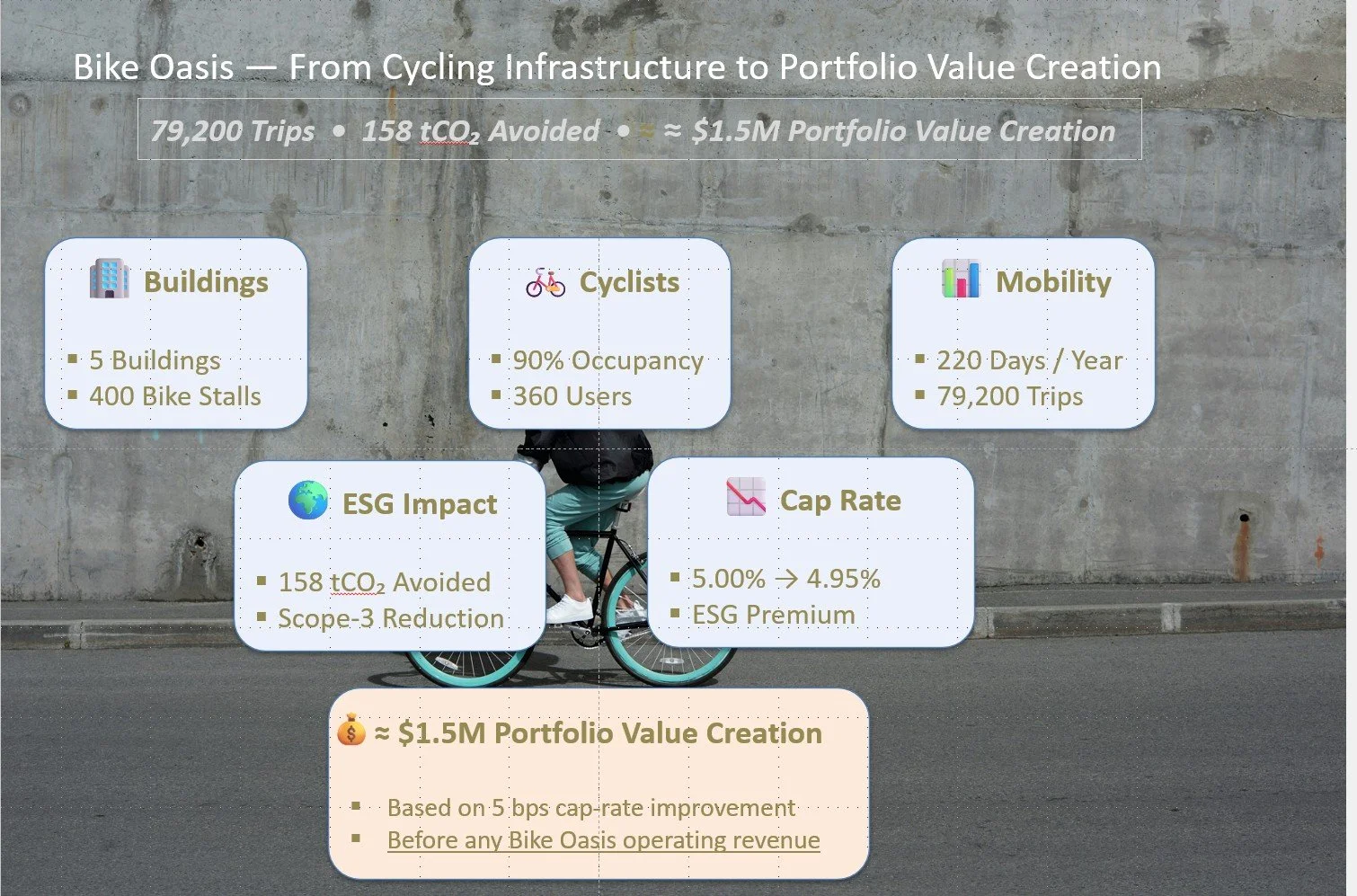
Portfolio Value Impact
A New Opportunity for Real Estate Owners and REITs
ESG Is Redefining What Makes Real Estate Valuable
Over the past decade, ESG considerations have moved from a compliance exercise to a strategic driver of real estate investment decisions.
Institutional investors, pension funds, and REITs increasingly evaluate assets based not only on financial performance but also on environmental impact, occupant well-being, and mobility patterns. While most real estate portfolios have focused heavily on energy efficiency and building operations, another major source of emissions often remains overlooked:
How people travel to and from the building.
This mobility layer represents one of the most significant yet least managed components of a building’s environmental footprint.
The Scope-3 Mobility Challenge
Commuting Emissions Are the Largest ESG Blind Spot
For many office and residential properties, commuting represents the largest share of emissions associated with the asset.
Employees, residents, and visitors generate thousands of trips each year.
These trips often rely on private vehicles, contributing to:
greenhouse gas emissions
congestion
parking demand
reduced urban livability
ESG reporting frameworks are increasingly requiring organizations to measure these Scope-3 emissions, including commuting.
However, real estate owners typically have very limited visibility into mobility behavior.
This is where infrastructure begins to play a strategic role.
Infrastructure Changes Behavior
Secure Cycling Facilities Unlock Active Mobility
Over the past five years, millions of bicycles and electric bikes have been sold across North America and Europe.
The vehicles already exist.
The missing element is often confidence at the destination.
Cyclists need to know that when they arrive at a building, they will find:
secure parking
protection from theft and vandalism
safe storage for high-value e-bikes
access available 24/7
When these conditions are met, cycling becomes a viable commuting option, even in dense urban environments.
Secure cycling infrastructure, therefore, becomes a mobility enabler, not just an amenity.
From Amenity to Data Infrastructure
The Role of Connected Mobility Platforms
Traditional bike racks offer little more than a place to lock a bicycle.
But when secure cycling infrastructure is integrated with a connected digital platform, something more powerful emerges.
Bike parking becomes a source of verified mobility data.
Digital access systems and connected infrastructure platforms can measure:
daily usage of cycling facilities
number of active cyclists in a building
frequency of trips
estimated vehicle trips replaced
associated CO₂ reductions
This transforms cycling infrastructure from a simple facility into a data-generating asset supporting ESG reporting.
Real Estate Portfolio Impact
When Mobility Infrastructure Creates Measurable Value
Consider a residential or mixed-use portfolio equipped with secure cycling infrastructure.
Assume:
400 secure bike spaces
90% utilization
220 cycling days per year per user
This generates approximately:
79,200 annual cycling trips
If each trip replaces a short car journey, the environmental impact becomes significant.
The result can include:
measurable Scope-3 emissions reductions
improved ESG reporting transparency
stronger sustainability metrics for investors
For institutional asset managers, these indicators increasingly influence capital allocation and portfolio attractiveness.
The Financial Dimension
ESG Performance Can Influence Asset Valuation
Capital markets are increasingly recognizing that sustainability performance influences asset liquidity, financing conditions, and valuation.
Even small improvements in perceived ESG performance can contribute to cap-rate compression, which directly affects asset value.
Mobility infrastructure that produces measurable environmental outcomes may therefore support:
improved ESG ratings
enhanced investor confidence
stronger positioning for sustainable finance
This reframes cycling infrastructure as more than a sustainability initiative.
It becomes part of the asset's strategic infrastructure.
The Next Layer of Urban Infrastructure
Secure, Connected, and Revenue-Generating
New infrastructure models are emerging that combine:
secure modular bike storage
integrated e-bike charging
smartphone-enabled access systems
connected digital platforms
These systems allow property owners to:
offer premium secure bike parking to tenants
generate recurring subscription revenue
measure mobility patterns
support ESG disclosure frameworks
In this model, cycling infrastructure evolves from static equipment into operational infrastructure within the building ecosystem.
Conclusion
Mobility Infrastructure Is Becoming a Strategic Asset
As cities transition toward lower-carbon transportation systems, buildings must also adapt.
The next generation of real estate assets will not only optimize energy performance but also enable sustainable mobility for their occupants.
Secure, connected cycling infrastructure represents a powerful opportunity to:
reduce commuting emissions
support active transportation
enhance tenant experience
generate measurable ESG data
In this context, bike parking is no longer simply a facility.
It is becoming a strategic layer of infrastructure linking mobility, sustainability, and real estate value.
ESG Frameworks Influencing Real Estate and REITs
Why Scope 3 Emissions Are Becoming the Next Major ESG Challenge for Real Estate and REITs
Environmental, Social, and Governance (ESG) considerations are rapidly transforming how real estate assets are evaluated by investors, lenders, and regulators. For Real Estate Investment Trusts (REITs) and institutional property owners, ESG performance is no longer a secondary metric — it is increasingly tied to asset valuation, capital access, and long-term portfolio resilience.
While much attention has traditionally focused on building efficiency and operational energy use, a growing shift is occurring toward Scope 3 emissions, which often represent the largest portion of a real estate asset’s carbon footprint.
ESG Frameworks Influencing Real Estate
1. ESG
Environmental • Social • Governance
ESG is the overarching framework used by institutional investors and REITs to evaluate the sustainability and resilience of real estate assets.
In the real estate sector, ESG typically includes:
Energy consumption and building efficiency
Carbon emissions and climate impact
Sustainable mobility and transportation access
Governance practices and risk management
Health, safety, and occupant well-being
Strong ESG performance increasingly influences:
asset attractiveness to investors
long-term asset value
access to institutional capital
2. GRESB
Global Real Estate Sustainability Benchmark
GRESB is the leading ESG benchmark specifically designed for real estate portfolios and REITs.
It allows investors to evaluate and compare the ESG performance of real estate asset managers and property portfolios worldwide.
Key characteristics:
Global benchmarking platform for real estate sustainability
Standardized ESG reporting for property portfolios
Widely used by large institutional investors
GRESB scores are frequently used by pension funds and institutional capital allocators to guide investment decisions.
3. TCFD / ISSB
Climate and Sustainability Disclosure Frameworks
TCFD (Task Force on Climate-related Financial Disclosures) and the ISSB sustainability standards provide frameworks for reporting climate risks and carbon emissions.
These disclosure frameworks are increasingly integrated into financial and ESG reporting for REITs and real estate investment managers.
They promote:
transparency in climate risk exposure
standardized carbon emissions reporting
comparability across organizations and portfolios
As climate disclosure requirements expand globally, these frameworks are becoming essential components of institutional reporting.
4. Scope 3 – A Strategic Issue for Real Estate
Indirect emissions linked to building usage
Scope 3 emissions refer to indirect emissions associated with the broader value chain of an asset.
In real estate, these often include:
commuting emissions from employees and tenants
transportation to and from buildings
tenant-related energy and mobility impacts
For most organizations, Scope 3 emissions represent 70–90% of total emissions linked to a property portfolio.
Active mobility infrastructure — including secure bike parking and cycling access — plays an important role in reducing and measuring these emissions.
The Role of Active Mobility Infrastructure
Infrastructure that supports active transportation, such as secure bike parking and cycling facilities, can play a significant role in reducing commuting emissions.
Beyond supporting sustainable mobility, modern cycling infrastructure can also generate measurable data about mobility patterns, enabling property owners to better understand and quantify their environmental impact.
Strategic Opportunity for Real Estate Owners and REITs
The combination of secure physical cycling infrastructure and connected mobility platforms is creating a new opportunity for real estate owners and REITs to integrate measurable mobility solutions directly into their assets.
The Velovoute, a secure and modular bike-parking infrastructure designed for residential and mixed-use developments, provides the physical foundation for safe and convenient bicycle and e-bike parking within buildings. When paired with the Bike Oasis digital platform, this infrastructure becomes part of a connected mobility ecosystem capable of generating verified mobility data.
Together, The Velovoute and Bike Oasis transform cycling infrastructure from a simple amenity into a data-enabled sustainability asset.
This integrated approach enables property owners, asset managers, and REITs to:
measure reductions in Scope 3 commuting emissions associated with building users
strengthen ESG reporting and transparency through verified mobility data
demonstrate measurable sustainability performance to investors and stakeholders
support broader net-zero and urban mobility transition strategies
As ESG expectations continue to evolve across the real estate sector, the ability to quantify and verify mobility-related emissions reductions will become an increasingly valuable capability for institutional real estate portfolios.