Daniel Gelinas Daniel Gelinas

ESG Frameworks Influencing Real Estate and REITs

Why Scope 3 Emissions Are Becoming the Next Major ESG Challenge for Real Estate and REITs

Environmental, Social, and Governance (ESG) considerations are rapidly transforming how real estate assets are evaluated by investors, lenders, and regulators. For Real Estate Investment Trusts (REITs) and institutional property owners, ESG performance is no longer a secondary metric — it is increasingly tied to asset valuation, capital access, and long-term portfolio resilience.

While much attention has traditionally focused on building efficiency and operational energy use, a growing shift is occurring toward Scope 3 emissions, which often represent the largest portion of a real estate asset’s carbon footprint.

ESG Frameworks Influencing Real Estate

1. ESG

Environmental • Social • Governance

ESG is the overarching framework used by institutional investors and REITs to evaluate the sustainability and resilience of real estate assets.

In the real estate sector, ESG typically includes:

  • Energy consumption and building efficiency

  • Carbon emissions and climate impact

  • Sustainable mobility and transportation access

  • Governance practices and risk management

  • Health, safety, and occupant well-being

Strong ESG performance increasingly influences:

  • asset attractiveness to investors

  • long-term asset value

  • access to institutional capital

2. GRESB

Global Real Estate Sustainability Benchmark

GRESB is the leading ESG benchmark specifically designed for real estate portfolios and REITs.

It allows investors to evaluate and compare the ESG performance of real estate asset managers and property portfolios worldwide.

Key characteristics:

  • Global benchmarking platform for real estate sustainability

  • Standardized ESG reporting for property portfolios

  • Widely used by large institutional investors

GRESB scores are frequently used by pension funds and institutional capital allocators to guide investment decisions.

3. TCFD / ISSB

Climate and Sustainability Disclosure Frameworks

TCFD (Task Force on Climate-related Financial Disclosures) and the ISSB sustainability standards provide frameworks for reporting climate risks and carbon emissions.

These disclosure frameworks are increasingly integrated into financial and ESG reporting for REITs and real estate investment managers.

They promote:

  • transparency in climate risk exposure

  • standardized carbon emissions reporting

  • comparability across organizations and portfolios

As climate disclosure requirements expand globally, these frameworks are becoming essential components of institutional reporting.

4. Scope 3 – A Strategic Issue for Real Estate

Indirect emissions linked to building usage

Scope 3 emissions refer to indirect emissions associated with the broader value chain of an asset.

In real estate, these often include:

  • commuting emissions from employees and tenants

  • transportation to and from buildings

  • tenant-related energy and mobility impacts

For most organizations, Scope 3 emissions represent 70–90% of total emissions linked to a property portfolio.

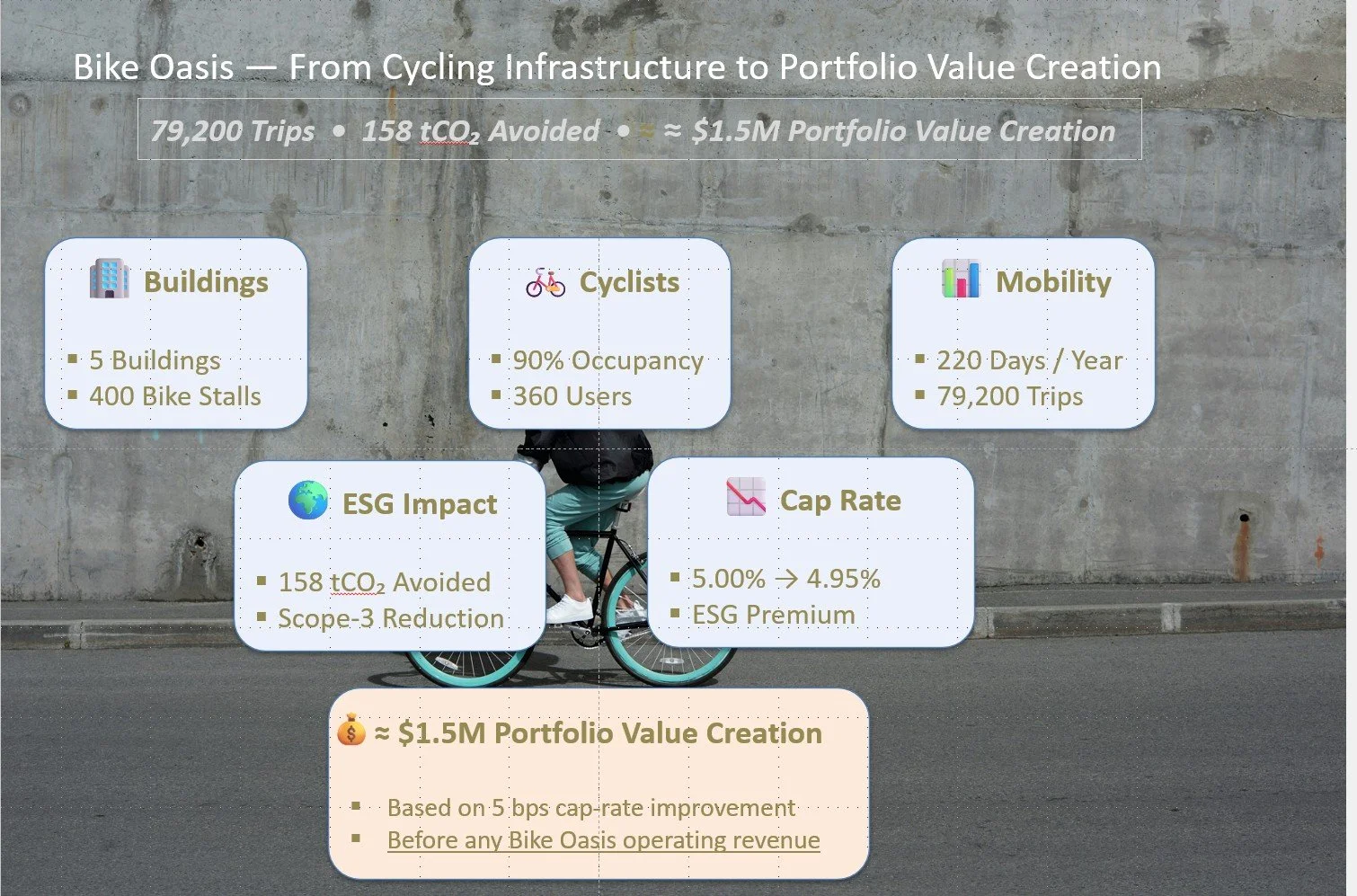
Active mobility infrastructure — including secure bike parking and cycling access — plays an important role in reducing and measuring these emissions.

The Role of Active Mobility Infrastructure

Infrastructure that supports active transportation, such as secure bike parking and cycling facilities, can play a significant role in reducing commuting emissions.

Beyond supporting sustainable mobility, modern cycling infrastructure can also generate measurable data about mobility patterns, enabling property owners to better understand and quantify their environmental impact.

Strategic Opportunity for Real Estate Owners and REITs

The combination of secure physical cycling infrastructure and connected mobility platforms is creating a new opportunity for real estate owners and REITs to integrate measurable mobility solutions directly into their assets.

The Velovoute, a secure and modular bike-parking infrastructure designed for residential and mixed-use developments, provides the physical foundation for safe and convenient bicycle and e-bike parking within buildings. When paired with the Bike Oasis digital platform, this infrastructure becomes part of a connected mobility ecosystem capable of generating verified mobility data.

Together, The Velovoute and Bike Oasis transform cycling infrastructure from a simple amenity into a data-enabled sustainability asset.

This integrated approach enables property owners, asset managers, and REITs to:

  • measure reductions in Scope 3 commuting emissions associated with building users

  • strengthen ESG reporting and transparency through verified mobility data

  • demonstrate measurable sustainability performance to investors and stakeholders

  • support broader net-zero and urban mobility transition strategies

As ESG expectations continue to evolve across the real estate sector, the ability to quantify and verify mobility-related emissions reductions will become an increasingly valuable capability for institutional real estate portfolios.

Read More