
1. The ESG Impact of Shifting Short Urban Trips from Cars to bikes/e-Bikes
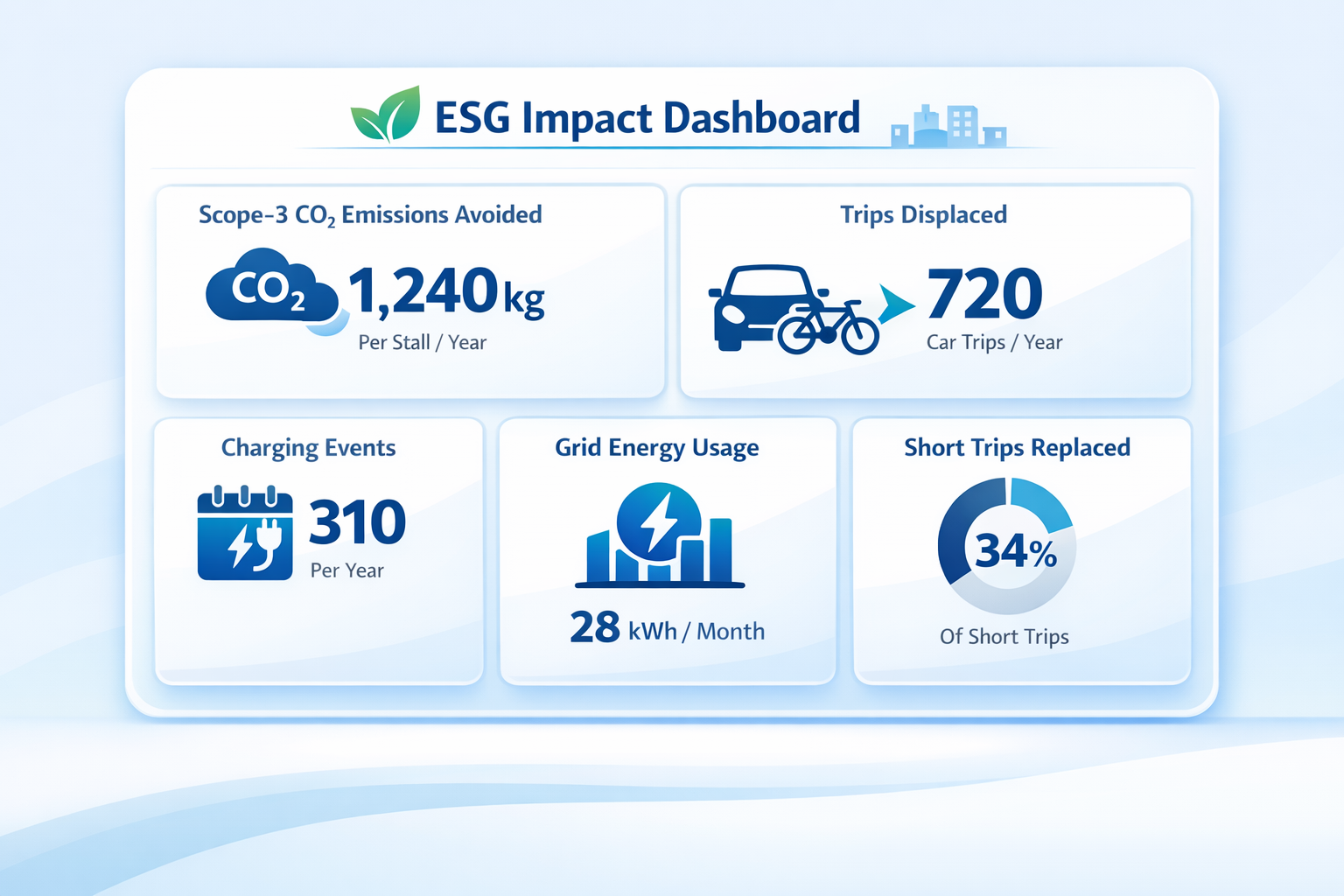
Scope-3 Active Mobility ESG Impact
Quantifying CO₂ Avoided, Grid Impacts, and Daily Trip Displacement Through Secure Parking Infrastructure
Short urban car trips—those under 7 km—represent one of the largest and most avoidable sources of transportation emissions in North American cities. They are also the easiest to replace with active mobility, especially e-bikes. But the transition is only possible when riders are confident that their bicycle or e-bike will remain safe, fully charged, and protected from fire risks throughout the day.
Secure end-of-trip infrastructure—such as the Velovoute family of solutions paired with the Bike Oasis digital platform—has emerged as a critical ESG lever capable of enabling large-scale mode shift while generating measurable environmental and operational value.
This article quantifies the core ESG impacts: CO₂ avoidance, grid-friendly charging, and daily trip displacement supported by a single secure parking stall.
1. CO₂ Avoided per Stall: A High-Value Scope-3 Metric for Real Estate and Municipalities
Replacing a short urban car trip with an e-bike trip saves an average of 250 to 350 g of CO₂ per kilometre. In Canada and the U.S., the average replaced trip is 4–7 km.
A single e-bike trip avoids:
1.0 to 2.4 kg of CO₂
When measured across a secure parking stall that supports multiple daily users, the cumulative impact becomes significant.
CO₂ Avoidance per Stall (Annualized)
Assuming a conservative 2 displaced car trips per weekday:
Trips avoided per year: ~500
CO₂ avoided per year per stall: 500 to 1,200 kg CO₂e
CO₂ avoided for a 40-stall installation: 20–48 tonnes CO₂e/year
This is fully aligned with Scope-3 “Avoided Emissions” reporting increasingly used in ESG strategies for:
Real estate investment trusts (REITs)
Large employers and campuses
Municipal climate plans
QSR networks looking to reduce delivery fleet emissions
Infrastructure that supports daily mode shift is now one of the most cost-efficient ESG initiatives available to property owners.
Explore secure bike parking, smart access, and e-bike charging solutions:
• Velovoute • Bike Oasis
#UrbanMobility #ActiveTransportation #Micromobility #SmartCities #VisionZero #ESG #FutureOfCities #BikeInfrastructure #PeaceOfMind