
The New Mobility Imperative: Replace What We Can, Protect What We Can’t
The Next Bicycle Revolution: From Personal Mobility to Strategic Resilience
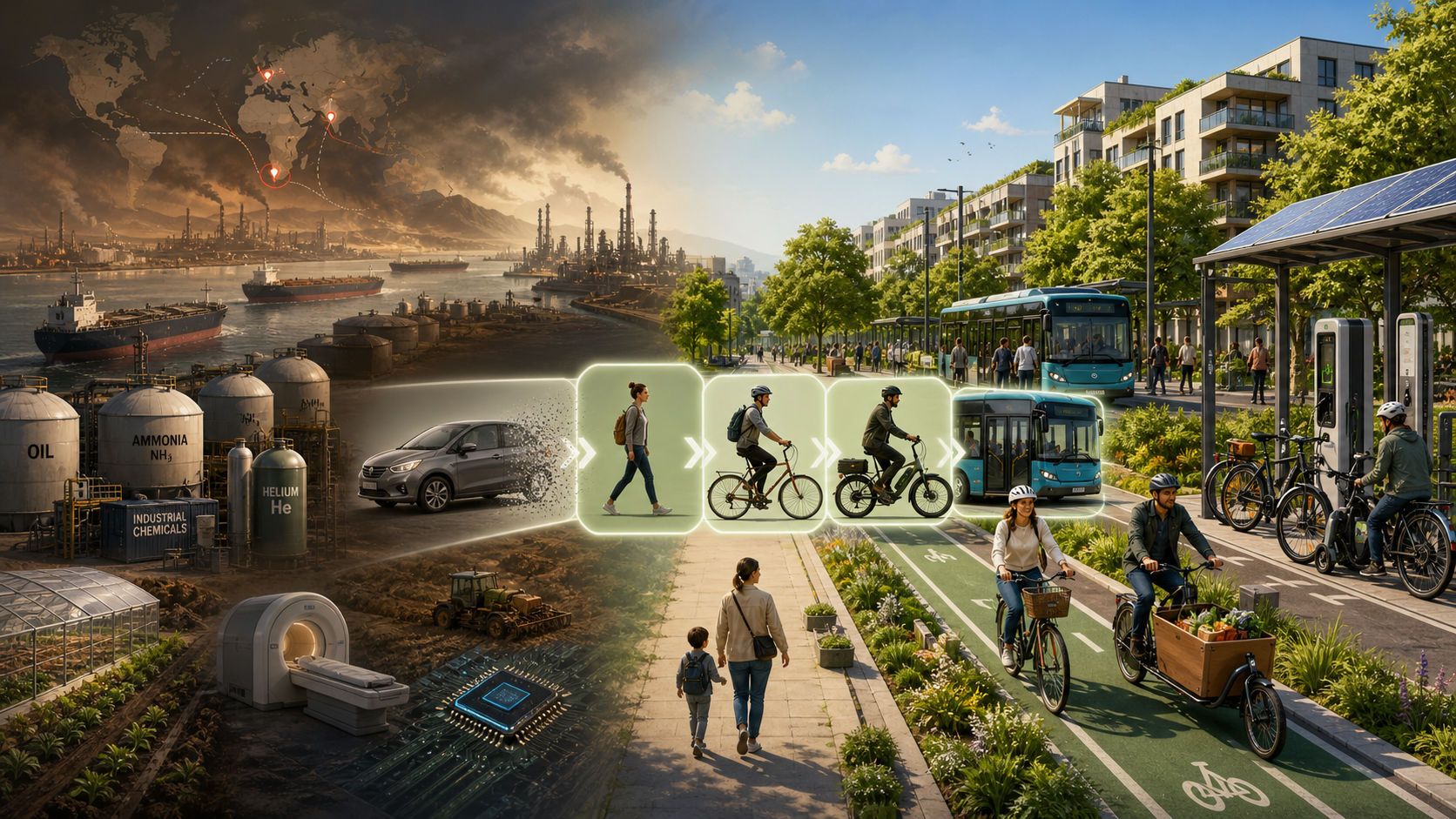
The bicycle has transformed society several times since its introduction. At first, it gave people something simple but revolutionary: the ability to move independently, farther than walking distance, without a horse, fuel, or driver. Later, the safety bicycle made cycling accessible to a much broader population. Pneumatic tires made riding more comfortable. Better gears, brakes, frames, and materials made bicycles more practical, efficient, and adaptable. Then came mountain bikes, cargo bikes, and eventually e-bikes, each expanding what cycling could do and who could realistically use it.
But the next bicycle revolution may be the most important one — because it is no longer only about the bicycle itself. It is about resilience.
The current geopolitical crisis around Iran is a reminder that mobility is not simply a climate issue. It is also an energy-security issue, an economic-resilience issue, and a supply-chain issue. When oil, gas, shipping routes, fertilizers, industrial gases, and critical chemicals become vulnerable, societies need to make smarter choices about what can be replaced and what cannot.
Many short car trips can be replaced. A trip to the store, to school, to work, to transit, to a café, to a community facility, or to a nearby appointment can often be made by walking, cycling, using an e-bike, taking public transport, or combining these options into one practical daily mobility system. Not every trip can be replaced. Not every person can cycle every day. Not every community has the same infrastructure. But enough short trips can be replaced to make a difference.
The strategic point is that some things are much harder to replace. We cannot easily replace nitrogen-based fertilizers needed to grow food. We cannot easily replace helium used in medical imaging, semiconductors, fibre optics, aerospace, and advanced manufacturing. We cannot easily replace many of the critical chemicals, industrial gases, and feedstocks that support agriculture, healthcare, construction, technology, and food systems.
That is the fundamental difference. A 5 km car trip is often optional. Fertilizer for food production is not. Medical gases are not. Semiconductor inputs are not. Critical industrial chemicals are not.
This is why active mobility must be understood differently. It is not only an environmental choice or a lifestyle preference. It is a resilience strategy.
The first bicycle revolutions were mechanical. They gave us better frames, better tires, better brakes, better gears, better comfort, and better performance. The e-bike revolution went further by removing many of the traditional barriers to cycling: distance, hills, age, fitness, wind, sweat, and cargo. Suddenly, many people who would never have considered themselves cyclists had a practical alternative for everyday trips.
Now the next revolution must be infrastructural. People will not replace more car trips unless the full journey works. They need to know that they can park safely, leave their e-bike without worrying, charge if needed, store a helmet, bag, or battery, connect easily to public transport, and rely on the system every day.
For many people, the biggest barrier is not the ride. It is the arrival.
That is why secure end-of-trip infrastructure matters. Bike lanes are essential, but they are not enough on their own. Communities also need secure, reliable, visible, and practical bike and e-bike parking, charging options, storage, digital access, clear information, and better integration with transit, housing, workplaces, schools, shops, and public spaces.
A resilient mobility system is not built during a crisis. It is built before the crisis. It gives people options. It reduces exposure to fuel-price shocks. It reduces pressure on household budgets. It reduces unnecessary car dependency. It supports local businesses. It strengthens public transport. It also helps preserve essential energy and chemical resources for uses that are harder to replace.
This is not about eliminating cars. Cars will remain necessary for many people, many places, and many types of trips. But the car should not be the default answer for every local movement.
The opportunity is clear. Communities can build a more resilient and sustainable mobility system by focusing first on the trips that are easiest to replace: walkable short trips, bikeable local trips, e-bike commutes, cargo-bike errands, transit-connected journeys, and secure end-of-trip infrastructure at destinations.
The next bicycle revolution is not about convincing everyone to become a cyclist. It is about giving people real alternatives. It is about protecting essential resources. It is about recognizing that some trips are optional by car, while some resources are not optional at all.
We can replace a short car trip with a walk, a bike ride, an e-bike, or public transport. But we cannot easily replace the critical inputs that grow our food, power our medical systems, support our technology, and sustain our industrial economy.
That is why active mobility is no longer only about sustainability. It is about resilience.
The most resilient litre of fuel is the one we do not need to burn. The most resilient mobility system is the one that gives people real alternatives before the crisis arrives.