
3. Grid Impacts: Modern E-Bike Charging Is Exceptionally Light
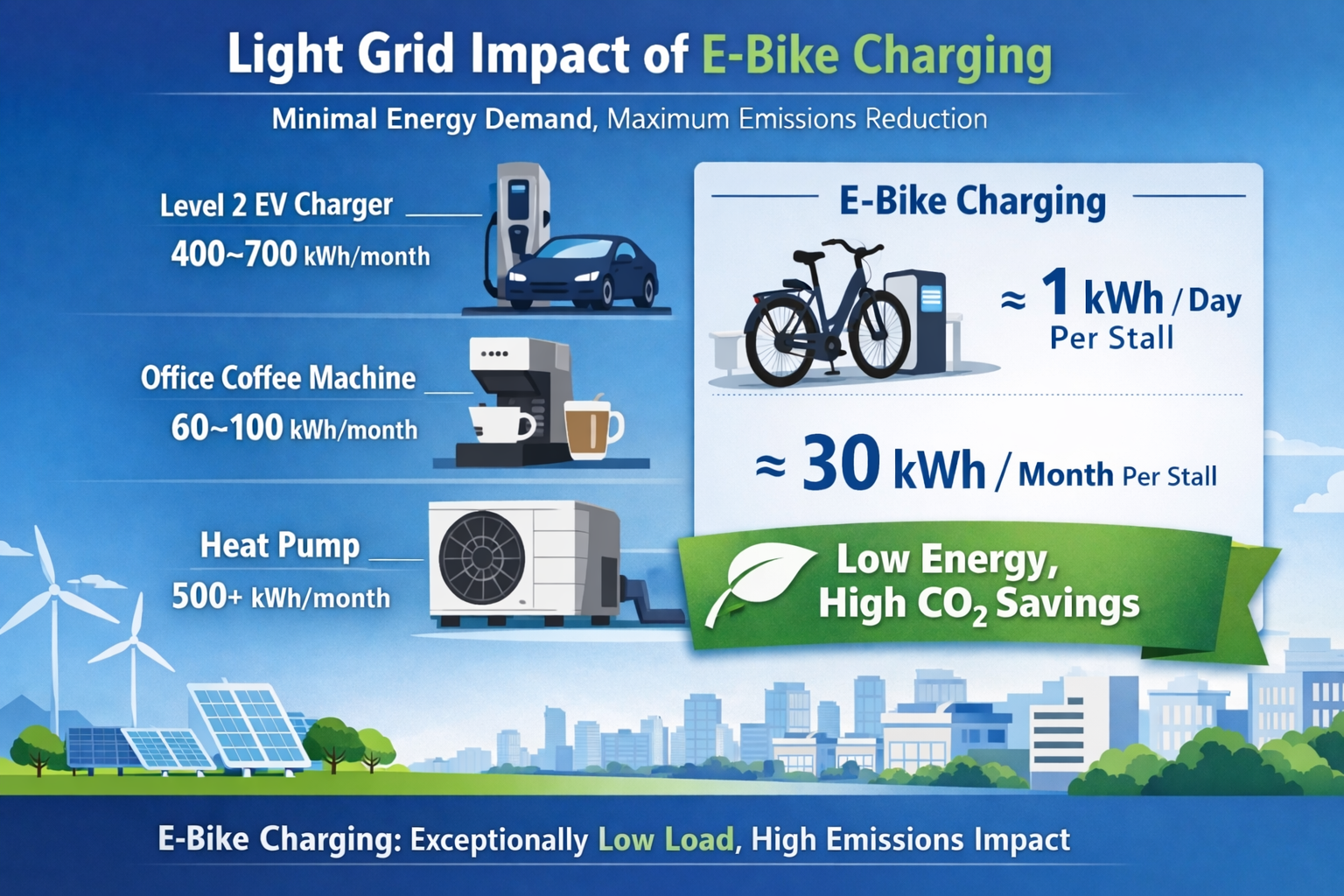
Light Grid Impact of eBike Charging
One of the most persistent misconceptions surrounding e-bike infrastructure is that charging represents a meaningful burden on building electrical systems or local grids. In reality, e-bike charging is one of the lowest-impact electrification loads available.
A typical e-bike battery operates within the following range:
Capacity: 400–700 Wh
Charging power: 70–150 W
Electricity per full charge: ~0.5 kWh
Even under a conservative scenario—two full charges per stall per day—the total demand remains minimal:
~1 kWh per day per stall
~30 kWh per month per stall
Putting this into perspective
To contextualize this load:
A Level 2 EV charger typically consumes 360–720 kWh/month
An office coffee machine consumes 60–100 kWh/month
A heat pump can exceed 500 kWh/month, depending on climate and usage
Against these benchmarks, e-bike charging is almost negligible—yet the emissions avoided per kilowatt-hour consumed are disproportionately high.
This combination of very low energy demand and very high emissions displacement explains why secure, controlled e-bike charging is increasingly integrated into decarbonization, ESG, and energy-transition strategies across real estate portfolios and campuses.