
Unlocking Everyday Bike Mobility
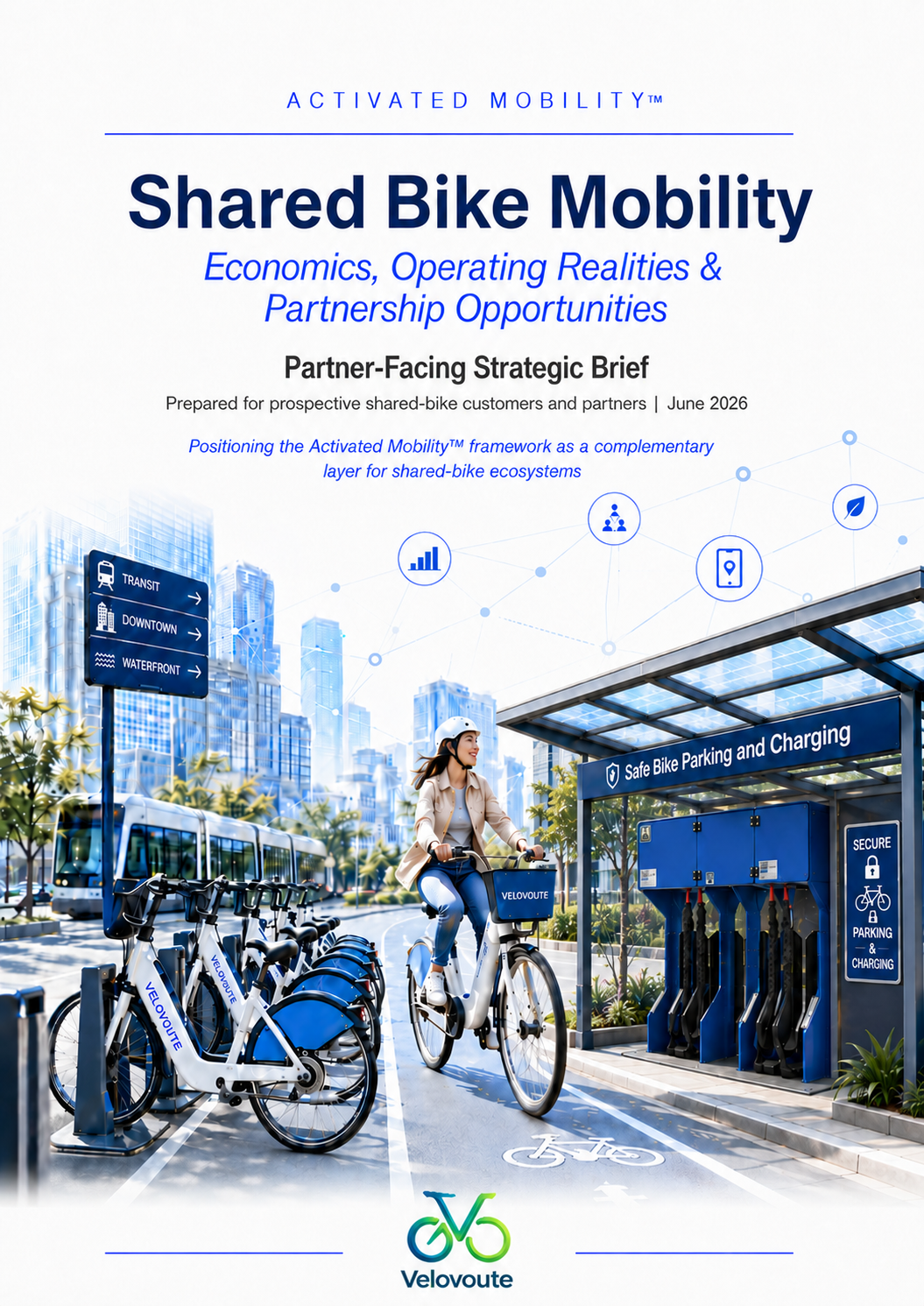
The connection between bike-share, public transit, secure bike parking, and e-bike charging in a modern urban setting. The image highlights how destination infrastructure can support both shared bikes and privately owned bikes as part of a broader active mobility ecosystem.
Across North America, cities are investing in bike-share systems, safer streets, cycling infrastructure, transit integration, and climate action plans. These investments matter. They make active transportation more visible, more legitimate, and more accessible. But there is another transportation fleet we rarely talk about.
It is not owned by a city.
It is not waiting for a procurement process.
It does not need a new operating contract, a docking station network, or a multi-year rollout.
It is already here. It is the bike in the garage. The e-bike in the condo storage room. The cargo bike in the shed. The adaptive bike in the basement. The commuter bike bought with good intentions, but used far less than expected. Together, these privately owned bikes and e-bikes may be one of the largest underused transportation assets in North America.
The issue is not always access to a bike
Bike-share is built around a simple premise: people need access to a bike. In many situations, that is absolutely true. Bike-share is valuable for residents, visitors, commuters, students, and anyone who needs a quick one-way trip. But it is only part of the story. Many people already own a bike or an e-bike. They are not waiting for a vehicle. They already have one. What they are missing is confidence that the trip will work from start to finish. And very often, the biggest concern is not the ride.
It is the arrival.
Where do I leave my bike when I get there? Will there be a secure place? Will my e-bike still be there after work? Can I safely leave my battery, helmet, bag, or accessories? What if it rains? What if I am away for several hours? Those questions are enough to keep thousands of bikes sitting at home.
Arrival is the missing link
A bike trip has three parts: 1-leaving, 2-riding, and 3-arriving.
Cities have made real progress on the first two. More bike lanes are being built. Bike-share systems are expanding. E-bikes are helping people travel farther, climb hills more easily, and reduce the effort required. But arrival is still the weak point. A bike lane can get someone to a destination. It does not protect a $4,000 e-bike for eight hours. A sidewalk rack may work for a quick stop. It does not provide the same confidence for a full workday, a transit connection, a school visit, or an evening downtown. This is where many potential bike trips break down.
Not because people do not want to ride.
Not because they do not own a bike.
Not because the trip is too far.
They break down because the destination does not feel secure.
E-bikes make this more urgent
The rise of e-bikes changes everything. An e-bike is not just a bicycle. It is a higher-value vehicle with a battery, electronics, a charger, accessories, and often a setup that is very specific to the rider. For many people, an e-bike can replace short car trips, extend commuting range, make hills manageable, and make daily cycling realistic. But the more valuable the bike, the greater the concern. Theft risk matters more. Weather exposure matters more. Battery storage and charging matter more.
A basic bike rack may have been enough for a low-cost city bike. It is far less convincing for an e-bike, a cargo bike, or a family transportation setup. If cities want people to use the bikes they already own, destination infrastructure has to catch up.
Activating the fleet that already exists
That is the idea behind Activated Mobility™. Instead of focusing only on adding more shared bikes to the street, Activated Mobility™ focuses on unlocking the potential of the bikes and e-bikes people already own. The goal is not to compete with bike-share. The goal is to complete it.
Bike-share provides access to a public fleet. Activated Mobility™ helps activate the private fleet by solving the arrival problem. Together, they can serve different users, different trips, and different parts of the city. A bike-share user arriving somewhere without secure parking faces a similar problem as someone riding their own e-bike. In both cases, the question is the same:
What happens at the end of the trip? That is the missing layer.
Why secure arrival infrastructure matters
Secure arrival infrastructure changes behaviour because it changes confidence before the trip even starts. When a cyclist knows there is a secure space waiting at the destination, the decision becomes easier. The trip becomes planned instead of uncertain. The bike becomes a real transportation option, not just something used on weekends. This matters for commuters, students, transit users, visitors, families with cargo bikes, employees at public buildings, people with adaptive bikes, and e-bike owners who need secure storage and charging options.
In each case, the bike may already exist. The missing piece is the destination.
A faster layer for cities
Municipal bike-share networks require planning, procurement, stations, operations, redistribution, maintenance, and sustained public funding. These systems can be valuable, but they take time to build and expand. Secure modular parking infrastructure can move faster.
A Vélovoûte site can be installed near a transit hub, municipal building, school, commercial street, workplace, library, park, or community destination. It can support existing cyclists right away, while larger public mobility programs continue to evolve. For cities, this is a practical opportunity: strengthen active mobility without waiting for every piece of a bike-share network to be in place.
The opportunity for North American cities
North America’s active transportation future will not be built by one solution alone. It will take bike-share, public transit, safer streets, e-bikes, secure parking, better data, employer participation, and infrastructure that reflects how people actually move. The bike in the garage is part of that future.
So is the e-bike in the condo locker.
So is the cargo bike that could replace a second car.
So is the adaptive bike that gives someone independence.
So is the commuter bike that would be used more often if the destination felt secure.
For cities, the question is not only how many bikes can be added to the public realm. It is how many existing bikes can be put to work.
One of North America’s largest underused transportation fleets may already be parked at home.
The next step is to make the other end of the trip secure enough for people to use it.