
Bike-Positive Infrastructure
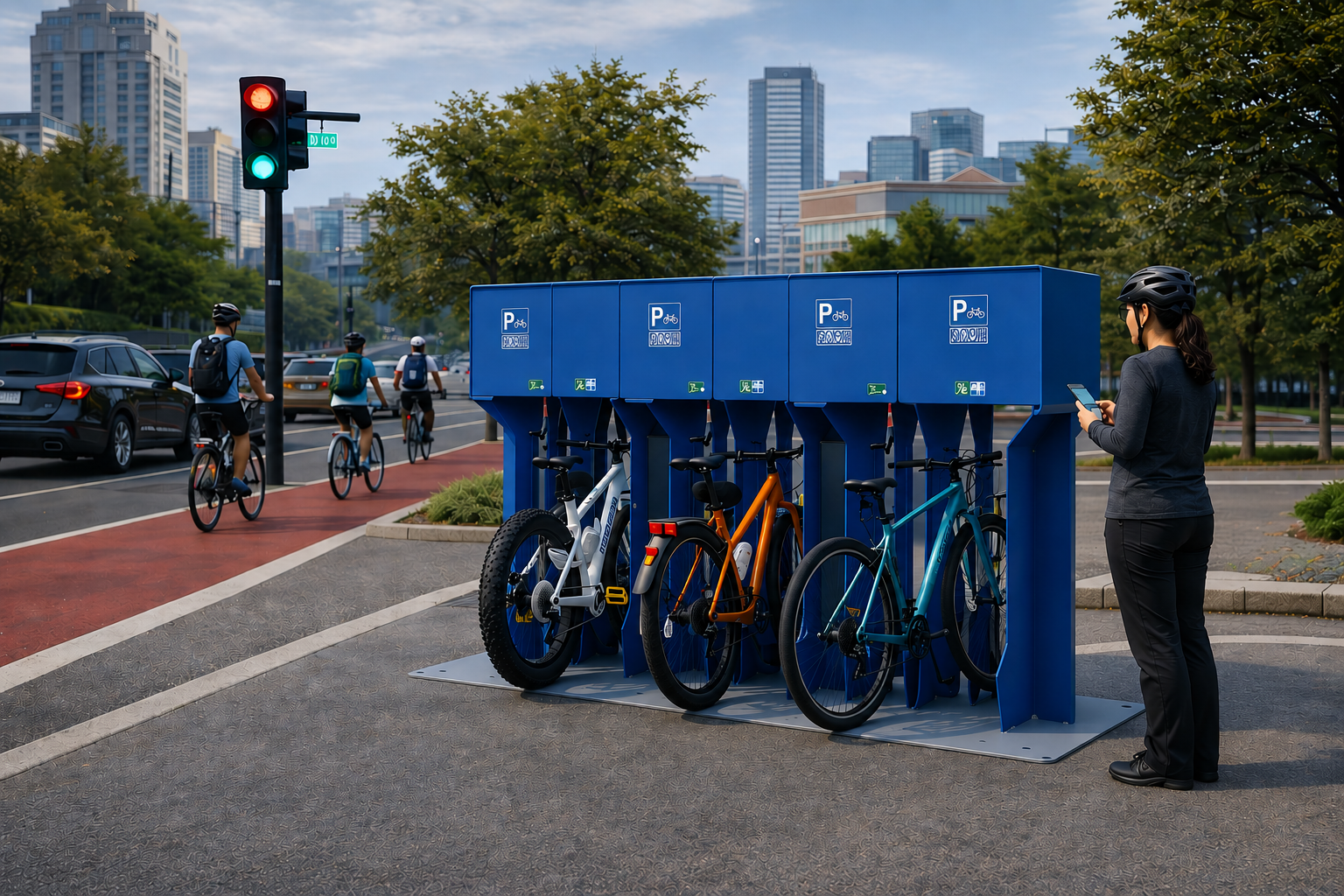
Bike-Positive Infrastructure Begins at Arrival
Travel choices are determined by the infrastructure that is available to us
For decades, transportation planning has largely been built around one assumption: people will adapt to the infrastructure we provide. And they do.
When cities build highways, parking lots, and wide arterial roads, people drive. When cities build safe sidewalks, connected cycling corridors, reliable transit, and secure arrival infrastructure, people walk, ride, and use transit more often.
Travel behaviour is not simply a matter of personal preference. It is deeply shaped by the environment around us. This is why the concept of bike-positive infrastructure matters.
The work of Antón-González et al. (2026) reinforces something many people already experience intuitively in their daily lives: transportation choices are strongly influenced by the quality, continuity, safety, and usability of the infrastructure available to them.
The implications are significant.
If mobility patterns are infrastructure-driven, then congestion, emissions, sedentary lifestyles, and transportation dependency are not simply behavioural problems. They are also design outcomes.
Infrastructure is not neutral
Infrastructure quietly communicates priorities.
A protected cycling corridor sends one message.
A six-lane arterial road sends another.
A secure bike parking facility says:
You are expected here.
A rusted bike rack hidden behind a building says the opposite.
People constantly evaluate risk, convenience, predictability, and comfort when choosing how to move. Most people are not anti-bike. Most people are uncertainty-averse.
Can I arrive safely?
Will my bike still be there afterward?
Can I charge my e-bike securely?
Will I be forced to bring a lithium battery into my apartment, office, or storage room?
Can I rely on this option every day, year-round?
Those questions are often far more important than enthusiasm for cycling itself.
The missing layer in mobility discussions
Much of the public conversation still focuses on movement corridors: bike lanes, transit routes, traffic flow, and vehicle technologies. But one of the least discussed — and most decisive — elements remains the arrival experience.
This is where many mobility systems quietly fail. A person may have a viable route to work by bike, yet still choose to drive because the destination lacks secure parking, charging capability, weather protection, or confidence. That is not a cycling problem. It is an infrastructure gap. This is particularly important in the era of electric bikes.
E-bikes are changing mobility mathematics entirely. Longer distances become realistic. Hills become manageable. Older demographics become active riders. Commuting becomes practical in many suburban environments.
But e-bikes also introduce new infrastructure expectations:
secure storage
battery charging
fire-conscious integration
weather protection
operational reliability
Without these conditions, adoption eventually reaches a ceiling.
Bike-positive infrastructure is about enabling, not forcing
One of the biggest misconceptions surrounding active mobility is the idea that it requires forcing people out of their cars. In reality, the most successful mobility systems simply expand viable choices. People respond to systems that work.
That is why bike-positive infrastructure should not be viewed as a niche cycling amenity. It should be understood as part of a broader resilience strategy for cities, campuses, commercial districts, transit hubs, and real estate portfolios. The goal is not ideological. The goal is optionality.
Resilient transportation systems are systems where people have multiple reliable ways to move — especially during periods of economic pressure, fuel volatility, infrastructure stress, or changing urban density patterns.
The infrastructure determines the outcome
We often debate mobility as though travel behaviour exists independently from the built environment. But infrastructure shapes probability. It shapes friction. It shapes confidence. And ultimately, it shapes behaviour.
If we continue building environments optimized almost exclusively for automobiles, we should not be surprised when automobile dependency persists. But if we build environments that genuinely support active mobility — safely, predictably, and at scale — travel behaviour changes.
Not because people suddenly changed.
Because the infrastructure finally did.